Preparing for Open Enrollment 2027 – Part 3
From Plan Design to Launch Day
Part 1 of this series covered the 2027 calendar, the new figures, and how to review your benefits package. Part 2 covered enrollment rules: Section 125 requirements, active versus passive (evergreen) elections, and the risks of rolling elections forward.
Part 3 is about execution. A well-negotiated renewal and a compliant cafeteria plan document will not help much if the rollout breaks down. A good open enrollment not only opens and closes on time. It is one where employees understand what they are choosing, make deliberate decisions, and start January 1 with coverage that works.
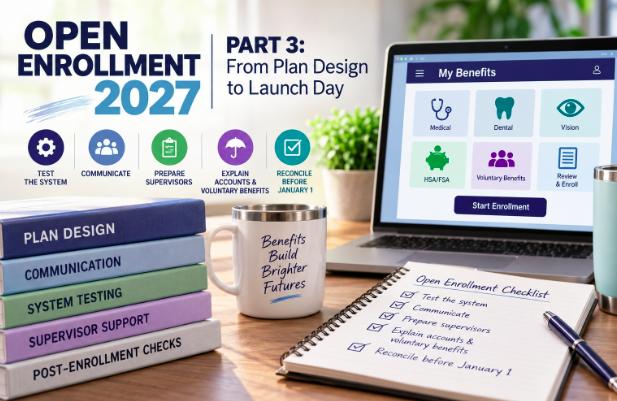
The steps below follow this order of operations: test the system, communicate, prepare supervisors, explain the accounts and voluntary benefits, and reconcile everything before the new plan year.
1. Test the System Before Employees See It
Most enrollment problems start in setup, not in the employee’s choices. Before the window opens, run test enrollments in your benefits administration system or carrier portal and confirm that what employees see matches what the plan documents say.
Create a handful of test profiles that reflect your real workforce, such as a full-time employee with family coverage, a part-time employee near the eligibility threshold, a new hire mid-waiting period, and an employee on leave. Then check:
- Rates and tiers. Every plan, tier, and per-paycheck deduction matches the final 2027 renewal.
- Eligibility rules. Hours thresholds, waiting periods, and dependent age limits work as written.
- Election logic. If you moved from passive to active enrollment (Part 2), confirm the system does not carry 2026 elections forward for anyone who does not act.
- Required documents. Dependent verification, spousal attestations, and waiver forms appear where they should and can be uploaded.
- Payroll codes. Each election maps to the correct deduction code and pre-tax or after-tax treatment.
Fix errors before launch. Correcting a rate after 200 employees have enrolled is far harder than correcting it in a test record.
2. Communicate More Than Once
Many employees spend little time on their benefit elections and simply keep what they had last year, even when premiums or their own circumstances have changed. One all-staff meeting or a long benefits guide will not change that. Plan several shorter messages, each with one job:
- Three to four weeks before the window opens: announce the dates. Name the key changes, such as new contribution tiers, a network change, or a move to active enrollment.
- One to two weeks before the window opens: share side-by-side comparisons. Show what each option costs per paycheck next to the deductible and out-of-pocket maximum. Employees understand paycheck impact faster than insurance terms.
- When the window opens: launch enrollment and offer help. Hold drop-in sessions, in person or virtual, where employees can ask questions about their own situations.
- Three days before the window closes: send targeted reminders. Contact only the employees who have not logged in, have not completed required elections, or still owe documents.
For school districts and other employers with staff who rarely check email, such as bus drivers, food service, and custodial staff, add paper notices and short messages at staff meetings.
3. Prepare Supervisors
Employees often ask their supervisor before they ask HR. An unsure supervisor can pass along incorrect information or downplay a deadline. Give supervisors three things:
- The deadline and why it is firm. Under Section 125, elections are generally locked for the plan year. After the window closes, changes are allowed only for qualifying events such as marriage, birth, or loss of other coverage. An informal exception in January is not an option.
- Where to send questions. A short list with the benefits portal link, the HR contact, and the broker or carrier service line.
- A confidentiality reminder. HIPAA generally governs health plans and providers rather than employers (HHS), but other laws and good practice still require discretion. Employees may share medical or family details when talking through their choices. Supervisors should not repeat that information or note it in personnel files, and they should not steer employees toward or away from any plan.
4. Explain the Accounts and Voluntary Benefits
Medical plans get most of the attention, but tax-advantaged accounts and voluntary coverage often offer the best value.
HSAs and FSAs. Explain the difference plainly. IRS Publication 969 covers both accounts in detail. A Health Savings Account is available only with a qualifying high-deductible health plan. The employee owns it, the balance carries over every year, and it moves with the employee if they leave. A health care Flexible Spending Account is tied to the employer and plan year. Unused funds are forfeited unless your plan offers a carryover or grace period, so tell employees which one applies. Use the 2027 contribution limits covered in Part 1.
Voluntary benefits. As deductibles and out-of-pocket maximums rise, accident, critical illness, and hospital indemnity plans can help employees cover costs a medical plan leaves behind. Present them as a supplement to medical coverage, not a replacement for it. Before enrollment, confirm with your broker whether premiums will be taken pre-tax or after-tax, because that choice affects how benefit payments are taxed.
5. Reconcile Before January 1
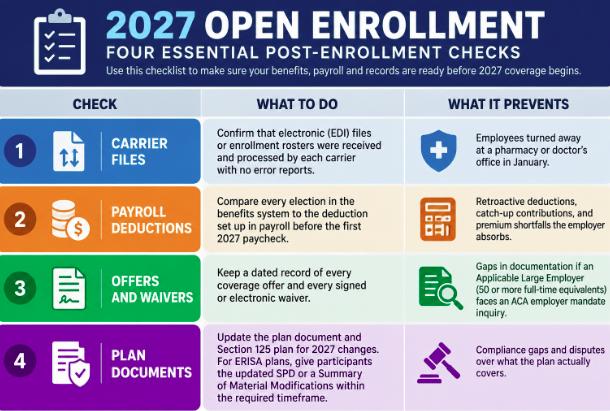
The work continues after the portal closes. Most administrative errors surface in the weeks between the end of enrollment and the start of the plan year. HR and finance should complete four checks together:
Public employers take note: governmental plans, including those of school districts and municipalities, are exempt from ERISA. They still need current plan documents, a written Section 125 plan, and clear notices under state law and the plan’s own terms.
Final Thoughts
Open enrollment is often treated as a once-a-year chore. Done carefully, it also sends a clear annual signal to employees that the organization manages their benefits with care.
This series moved from market conditions (Part 1), to plan rules (Part 2), to the rollout itself (Part 3). Employers who work through all three are better positioned to control costs, reduce compliance risk, and earn employee trust.
Further Reading
- Treas. Reg. § 1.125-4, Permitted Election Changes (eCFR): the events that allow mid-year cafeteria plan changes.
- IRS Publication 969: rules for HSAs, health FSAs, and HRAs, including carryover and grace period options.
- IRS: Employer Shared Responsibility Provisions: who counts as an Applicable Large Employer and what the ACA employer mandate requires.
- DOL: Reporting and Disclosure Guide for Employee Benefit Plans: SPD and SMM deadlines, including the 60-day rule for material reductions in group health benefits.
- DOL: ERISA and Health Plans: which plans ERISA covers, and the exemption for governmental and church plans.
- HHS: Employers and Health Information in the Workplace: how the HIPAA Privacy Rule applies, and does not apply, to employers.