September 30th Checkpoint!
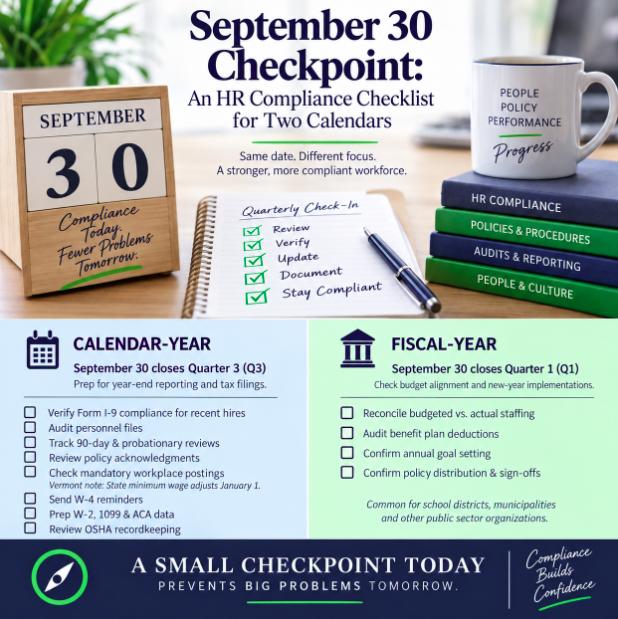
September 30th marks a critical compliance checkpoint for many organizations, though its significance depends entirely on your operational calendars:
- Calendar-Year Compliance: September 30 closes Quarter 3 (Q3)—the ideal window to prep for year-end reporting and tax filings.
- June 30 Fiscal-Year End Organizations: September 30 closes Quarter 1 (Q1)—the first true status check on budget alignment, open roles, and new policy rollouts (typical for many municipal bodies and school districts).
No matter which calendar obligations you need to review, using this date as an operational pause helps keep your HR systems compliant, accurate, and audit-ready before the next quarter begins.
Calendar-Year Obligations: Prepping for Year-End (Q3 Check)
Use the end of Q3 to clean up personnel records and lay the groundwork for smooth Q4 execution.
- Core HR & Onboarding Audit
- Verify Form I-9 Compliance for Recent Hires: Ensure every employee hired since July 1 has a fully completed Form I-9 with supporting identity and work authorization documents verified within the mandated timeframe.
- Audit Personnel Files: Confirm all Q3 hires have signed offer letters, background check clearances, applicable professional licensure documentation, and signed handbook acknowledgments.
- Track 90-Day & Probationary Reviews: Confirm supervisors have scheduled and documented performance reviews for all employees hitting their 90-day milestone this quarter.
- Policy & Compliance Postings
- Review Updated Policy Acknowledgments: If any handbook or workplace policies were updated this quarter, verify that signed acknowledgment forms are on file for all current employees and that new hires received the updated versions.
- Check Mandatory Workplace Postings: Ensure federal and state labor law postings are up to date across all physical work sites and accessible on digital portals for remote staff.NOTE: Many State minimum wages adjust annually on January 1. Check for updated late-fall poster releases and set a reminder to display them by January 1.
- Q4 Tax & Reporting Preparation
- Send Annual Form W-4 Reminders: Draft and schedule a reminder for employees to review and update their tax withholding elections before December 1.
- Prep Form W-2, 1099, & ACA Data: Audit employee personal details (legal names, SSNs, addresses) now so year-end tax form distribution is execution-focused rather than a data-reconstruction scramble.
- Review OSHA Recordkeeping: Ensure all workplace injuries, illnesses, and incidents from Q1–Q3 are accurately logged on your OSHA 300 form.
June 30th Fiscal-Year End: First-Quarter Calibration (FY Q1 Check)
For organizations on a July 1 fiscal calendar (such as school districts and public sector agencies). September 30 offers the first look at whether new-year implementations took hold as planned.
- Financial & Benefits Reconciliation
- Reconcile Budgeted vs. Actual Staffing: Compare approved fiscal budget allocations against current headcount, open postings, and contractor usage. Flag any variances early to prevent unexpected year-end budget shortfalls.
- Audit Benefit Plan Deductions: Verify that new plan-year benefit elections (health, dental, vision, FSA, and retirement contributions) are accurately reflected in payroll for all eligible staff, not just those who made active changes during open enrollment.
- Goal Setting & Policy Alignment
- Confirm Annual Goal Setting: Verify that managers and supervisors have documented performance goals for their teams. Clear Q1 goals eliminate documentation gaps during mid-year or annual reviews.
- Confirm Policy Distribution & Sign-Offs: If the board or leadership approved policy updates effective July 1, confirm they were distributed to all staff and acknowledged in writing.
The Bottom Line
A quarterly compliance audit does not need to be overly complicated—it just needs to be consistent. Organizations that embed a systematic review into their quarterly routine catch administrative oversight early, long before it escalates into audit penalties or legal risk.