Preparing for Open Enrollment 2027 – Part 2
Do You Understand Evergreen Enrollment Rules?
Last week, in Preparing for Open Enrollment 2027, Part 1, we reviewed the 2027 cost outlook, the new IRS and ACA figures, how to build your enrollment calendar, and your full benefits package. Part 1 also noted that many employees take no action at all and simply roll into last year’s coverage. This week is about what the law requires when that happens.
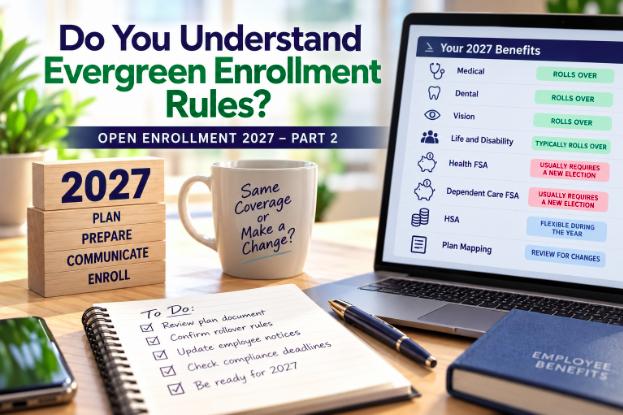
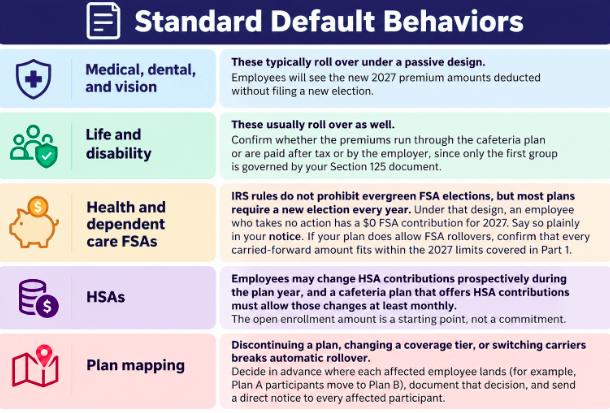
Passive enrollment, often called evergreen enrollment, lets employees who take no action during open enrollment keep their current elections. Section 125 allows it. The problem is not the rule. The problem is communication. When employees don’t know which elections carry forward and which don’t, questions arrive in January, on the first paycheck of the new plan year.
The Regulatory Framework
Two IRS sources support evergreen elections.
Revenue Ruling 2002-27 confirmed that a cafeteria plan may automatically enroll employees, provided they receive notice of the default and a chance to elect otherwise. For current employees, that notice comes before each plan year.
The 2007 proposed cafeteria plan regulations go further. They expressly permit automatic elections, including evergreen elections that carry an existing employee’s election into the next plan year (Proposed Treas. Reg. § 1.125-2(b)). Employers may rely on the proposed regulations until the IRS issues final regulations.
Two conditions apply:
- Your cafeteria plan document must authorize default or passive elections.
- The default must be in place before the new plan year begins. Section 125 elections are prospective, so you cannot apply a rollover after the plan year starts.
What the Notice Must Say
Passive enrollment works only if employees know how it works. Your open enrollment notice should state:
- That current elections will carry forward automatically if the employee takes no action.
- The employee’s specific current elections and the new 2027 premium cost for each.
- How to change or decline coverage.
- The deadline to make changes, and a reminder that elections are locked for the plan year unless the employee has a qualifying life event.
How Employer Type and Size Change the Rules
Evergreen enrollment works the same way on paper for every employer. The obligations around it do not. Whether you are a private company or a public entity, how many people you employ, and which state your employees work in all change what you must send, when, and to whom.
Private Employers vs. Public Employers: The Federal Picture
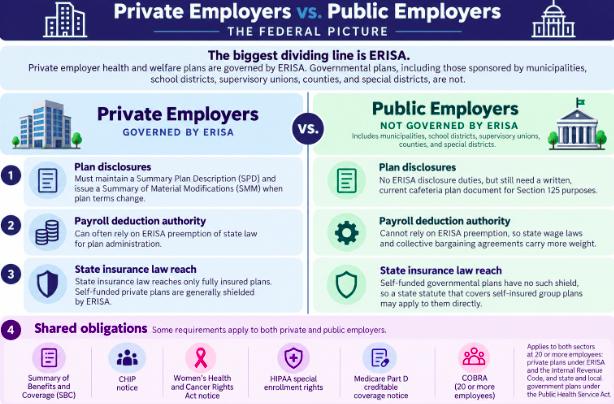
The biggest dividing line is ERISA. ERISA governs private employer health and welfare plans. Governmental plans, including those sponsored by municipalities, school districts, supervisory unions, counties, and special districts, are not.
That difference matters in four ways during open enrollment.
Size Thresholds That Affect Open Enrollment
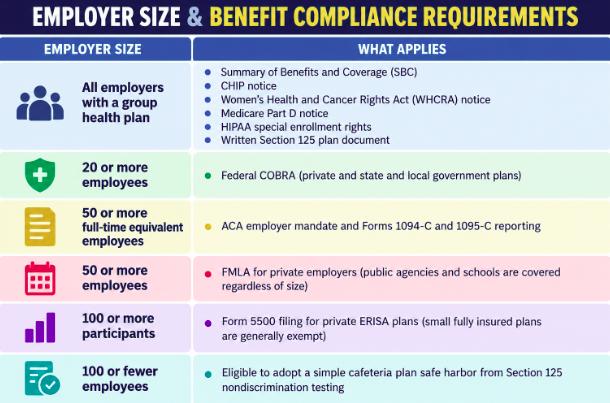
Three of these deserve a closer look during evergreen enrollment.
ACA affordability. Part 1 covered the 2027 affordability percentage. The evergreen issue is different. A rolled-over election carries the new 2027 employee contribution forward without anyone reviewing it. Applicable large employers should confirm that the rolled-over amount still meets their safe harbor for every full-time employee, including employees whose pay dropped during the year. Under the rate-of-pay or W-2 safe harbor, a pay reduction can make the same premium unaffordable for that one employee.
Employees on leave. FMLA requires the employer to maintain group health coverage on the same terms during leave. An employee on leave during open enrollment is entitled to the same materials and the same opportunity to change elections as everyone else. Don’t let leave status turn a passive rollover into an uninformed one.
Section 125 nondiscrimination. Testing applies to private employers of every size. A small employer that skips testing because it assumes it is too small to matter is taking a real risk. Employers with 100 or fewer employees may adopt a simple cafeteria plan, which provides safe harbor if the Plan meets the contribution and eligibility requirements under Code Section 125(j).
One more point for all employers: an employee who enrolls in Medicare can no longer contribute to an HSA. An evergreen HSA election for an employee who has enrolled in Medicare creates an excess contribution. Ask about Medicare enrollment in your open enrollment materials.
Essential Compliance Notices
Required notices are easy to lose during the enrollment push. Keep these on your calendar.
- Summary of Benefits and Coverage (SBC): When coverage renews automatically, the SBC must be provided no later than 30 days before the new plan year begins. For a January 1 plan year, that date is December 2, 2026. If renewal requires an application, provide the SBC with the application materials. This requirement applies to governmental group health plans and private plans.
- CHIP and WHCRA notices: Include the Children’s Health Insurance Program notice and the Women’s Health and Cancer Rights Act annual notice in your open enrollment packet.
- Medicare Part D creditable coverage notice: This notice was due before October 15, 2026. If it did not go out, send it now and document the date.
- Plan documents: If you changed plan structures or FSA rules, including any dependent care limit decision from Part 1, update your cafeteria plan document. Private employers also need to update their Summary Plan Descriptions or issue a Summary of Material Modifications. Governmental plans aren’t subject to ERISA disclosure rules, but the cafeteria plan document must still be written and up to date.
The Foundation Matters
Part 1 focused on locking in your numbers and calendar. Part 2 focuses on ensuring the defaults behind those numbers hold up. Most January enrollment problems start in October, with unmade administrative choices and outdated plan documents. Audit your Section 125 language, set clear rollover defaults, confirm the rules that apply to your sector, size, and state, and issue notices on schedule.
Next week in Part 3: End-to-End system testing, an effective communication strategy, and an operational checklist for a smooth launch.
References
- CKW Advantage, Preparing for Open Enrollment 2027, Part 1 (Oct. 12, 2026).
- Rev. Rul. 2002-27, 2002-1 C.B. 925.
- Proposed Treas. Reg. §§ 1.125-1, 1.125-2, 72 Fed. Reg. 43938 (Aug. 6, 2007).
- Internal Revenue Code § 125(j) (simple cafeteria plans).
- 29 C.F.R. § 2590.715-2715 and 45 C.F.R. § 147.200 (SBC requirements).
- ERISA § 4(b)(1), 29 U.S.C. § 1003(b)(1) (governmental plan exclusion).
- 29 U.S.C. § 1161 (COBRA, 20-employee threshold); 42 U.S.C. § 300bb-1 (COBRA for state and local government plans).
- 29 C.F.R. Part 825 (FMLA).
- 42 C.F.R. § 423.56 (Medicare Part D creditable coverage disclosure).
- U.S. Department of Labor, Model CHIP Employer Notice.