Human Resources in the Age of AI
I cannot remember the last conversation I had, TV show I watched, or post I read that did not in some way reference AI, or at least one of the many tools out there, whether it is Claude, Gemini, or something else. Remember when our biggest AI issue was arguing with autocorrect? Now we are navigating a world where you can tell a tool to create X, draft Y, and calculate Z.
How does this positively and negatively impact our world, and specifically our workplaces? This affects every employee, not just the HR team drafting the policy about it. Here are a few pros and cons to consider.
Proofreading & Suggestions:
- Pro: AI catches typos, awkward phrasing, and inconsistencies faster than a tired set of human eyes at 4:45 on a Friday. Whether you are drafting a client email, a handbook policy, or a project update, that is a real safeguard.
- Con: Over-reliance dulls our own editing instincts. If every document gets run through a tool before a human reads it critically, we risk losing the skill of catching our own mistakes, and the judgment to know when a suggested edit changes the meaning of something important.
Efficiency:
- Pro: Tasks that used to take all afternoon- scheduling interviews, drafting a first pass of a job description, summarizing a long report, can now take minutes. That time can go toward the parts of any job that actually require a person: a hard conversation, a judgment call, a relationship.
- Con: Efficiency without oversight creates its own risk. A faster process is not a better one if nobody is checking that the output is accurate, unbiased, and appropriate for the situation. Speed can quietly become a substitute for thoroughness, in any department.
Authenticity:
- Pro: AI can help someone who struggles to find the right words get a strong first draft down, which can make communication more accessible for anyone who is not a naturally confident writer, at any level of the organization.
- Con: People can tell when something does not sound like you. A customer email, a performance review, or a difficult message that reads as generic or AI-generated can undermine trust, even if the content itself is accurate.
A few other impacts worth naming:
- Skill erosion — If AI handles the first draft of everything, we risk a generation of employees, not just in HR, who never fully develop the underlying skills themselves.
- Uneven adoption — Some employees are comfortable experimenting with these tools. Others are anxious about them, or unsure if using them is even allowed. Without clear guidance, you end up with inconsistent practices and unspoken rules that vary by team and by department.
- Trust and job security — At a time when employees are already navigating a challenging economy and real uncertainty about their roles, the introduction of AI can feel like one more thing to worry about, not just how to use it, but whether it is quietly replacing them.
Where HR Comes In:
Every employee is forming their own opinion about AI right now, often without much guidance. That is where HR’s role matters most, not as the department that decides for everyone, but as the one that gives every employee, from the front line to leadership, a clear and consistent framework to work within.
A few starting points that make a real difference:
- Set clear, written guidelines on where AI use is encouraged, where it requires disclosure, and where it is off-limits, particularly for anything involving customer data, employee data, or personnel decisions
- Train managers and employees on how to use these tools well; don’t just hand them the tools to try to learn
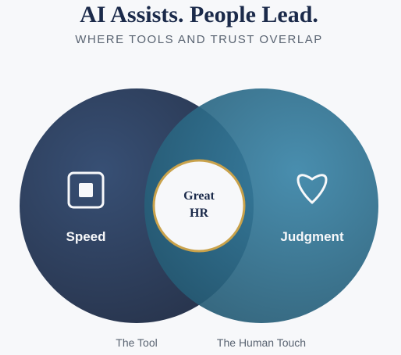
- Say out loud that AI is meant to support judgment, not replace it, and mean it in how the organization actually uses it
- Keep the human touch in the moments that call for it: recognition, difficult conversations, and anything tied to someone’s livelihood
AI is not going away, and pretending otherwise does not serve your employees or your organization. The goal is not to resist it or to hand everything over to it. The goal is to be intentional about where it helps and disciplined about where it should not lead, and to make sure every employee, not just HR, understands where that line is.
If you are trying to figure out what a responsible AI policy looks like for your organization, or how to prepare your entire workforce to use these tools well, that is exactly the kind of guidance CKW Advantage provides. Reach out and let’s build something that fits how your organization actually works.