“Microburst Learning”: Boosting Employee Info Retention

One of my favorite things as an HR Director was sharing quick, engaging, meaningful, and sometimes just humorous “thoughts” with our employees once a week. It also helped support a strategy for “Microburst Learning.” Traditionally, employers have relied upon the day-long in-service or company training approach. But how effective is it?
Not very, if you look at the numbers: about half of new information is forgotten within an hour of learning it, and 70 percent is gone within 24 hours. Give it a month and 90 percent of it is gone. Employers keep doing it anyway, which is why an estimated $130 billion is spent globally on learning and development each year, with only about a quarter of it judged effective. The training is not the problem. The format is.
Studies show that generational differences, along with varying learning styles, make it difficult for managers and trainers to keep employees engaged in such formats. Sure, in the first few days, a few will take the time to try to implement new learning, and managers will try to reinforce new expectations. But quickly, the stress will hit, retention will be nonexistent, and leadership will be frustrated when the company reverts to doing things the way it always has, or when individuals continue doing things the only way they feel comfortable. Even when organizations intentionally pursue new learning, the “implementation dip” can derail progress because management or corporate leaders grow frustrated when change is not immediate and sustained. Change theorist Michael Fullan coined the term to describe the year-one slump organizations go through when adopting something new — the fear of the unknown and uncertainty about new roles drags performance down before it improves. Knowing that going in is half the battle.
Studies show that there is a better way for almost all employees to learn. Parents, students, and educators are familiar with the term “differentiated learning.” It is not just a buzzword. We all learn differently. That is a fact. One study on active versus passive learning found employees retained 93.5 percent of material a month later when they learned through hands-on activities, gamification, and group discussion, compared to 79 percent for those who just sat and listened. In addition, to needing to understand learning styles, especially where time is limited, like it is in the “real world,” where “ongoing education” is often one of many tasks in daily and annual work expectations.
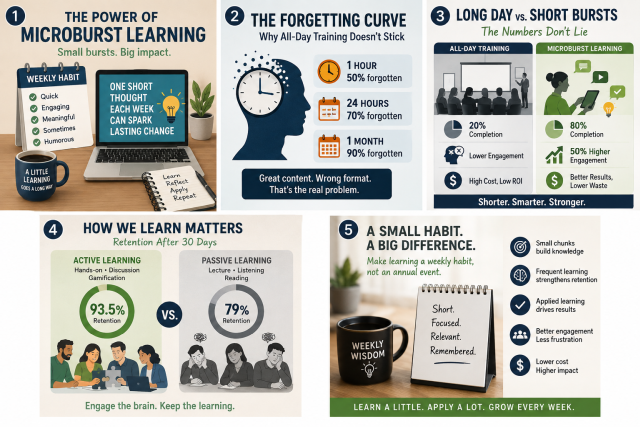
Now throw another buzzword into the mix, “Microburst Learning”. Don’t let the addition of another trendy-sounding word throw you. Understanding learning styles is a proven professional development strategy. Employees retain 20 to 60 percent more when they learn in short bursts instead of long sessions, and they actually show up for it — microlearning modules see about 80 percent completion, against 20 percent for the day-long format. Engagement runs about 50 percent higher, too, and 58 percent of employees say they’re simply more likely to pay attention when the content comes in shorter pieces. How many times have you heard someone say “If you only take one thing away from this presentation, this speech, this training…”? There is a reason for that.
Bottom Line
The day-long training isn’t dead because it’s a bad idea. It’s dead because the brain wasn’t built to hold onto it. Short, frequent, well-timed learning — delivered weekly instead of annually — sticks better, gets used more, and costs less in wasted budget and frustrated leadership. If your organization is still leaning on the all-day in-service as its main training tool, the research says it’s time to rethink the format, not the content.
Sources:
Fullan, M. — cited via Law Insider, “Implementation Dip”
Brainlenses, Ebbinghaus Forgetting Curve summary
Slideshare, “Beginner’s Guide to Learning Reinforcement & Microlearning”
Questionmark/Business Wire, “Employers Wasting Billions on the Wrong Training”
Bridge, “10 Facts and Stats About Learning Retention”
eLearning Industry, “Microlearning Statistics, Facts and Trends”
TechClass, “Microlearning: The Future of Employee Development”