Six HR Stages, One Broken Chain
Treat the Employee Lifecycle as a Connected System, Not Separate Checklists
One of my clients is currently restructuring its central office and rethinking how all of its business functions are organized — including HR — at a point where no one is quite sure what HR is supposed to cover. That conversation kept circling back to one theme: the lifecycle of an employee. When is the last time you thought about that cycle for your own organization?
You post the job. Run the background check. Hold the annual review. Send the exit survey. Most organizations still handle HR this way — as a string of separate events instead of one process. Each task gets done. Nobody watches how they connect. That’s the gap where turnover hides.
I’ve spent over 25 years watching the same pattern play out in organizations of every size: a weak spot in one stage of the employee lifecycle doesn’t stay contained. It shows up somewhere else, months later, looking like a different problem. A rushed hire becomes a performance issue. A skipped 30-day check-in becomes a resignation nobody saw coming.
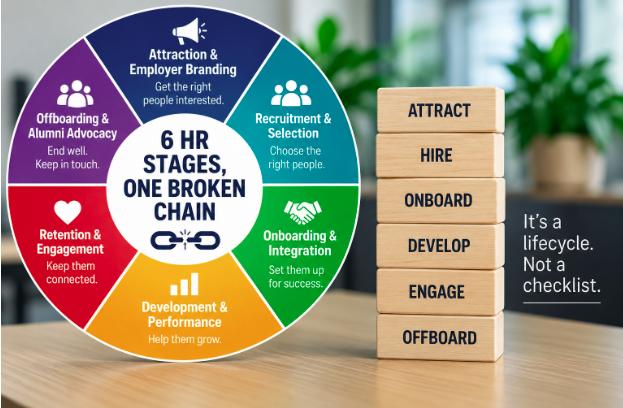
Below is how I think about the six stages and where I typically see organizations lose ground.
Attraction and Employer Branding
Candidates decide whether you are worth applying to long before they ever see a job posting. They check Glassdoor. They ask someone who already works for you. By the time your opening goes live, a chunk of your candidate pool has already made up its mind.
A few things I look at first when a client’s pipeline is thin: Does the careers page show anything real, or is it stock photos and a benefits list? Does the job posting read like a wish list of 25 requirements, or does it describe what success looks like in the first few months?
None of this requires a bigger recruiting budget. It requires someone to look at what candidates see and ask whether it’s true.
Recruitment and Selection
How you run an interview process tells a candidate how your organization runs, period. A hiring loop that drags on for two months, with no updates in between, is not a neutral inconvenience. It’s a preview.
A structured process solves two problems at once. Use the same core questions across candidates for a given role, and you reduce bias while making your comparisons meaningful. Keep it to two or three rounds. And treat the interview as a two-way conversation: the candidate is evaluating you too, and pretending otherwise wastes everyone’s time.
Onboarding and Integration
This is where I see the most expensive mistakes, and the data backs that up. Gallup has found that only about 1 in 8 employees strongly agree their organization does onboarding well.¹ SHRM’s research shows employees who go through a structured onboarding process are considerably more likely to stay past three years, and organizations with strong onboarding programs report significantly higher new-hire retention.²
Onboarding is not day-one paperwork. It’s a multi-month process, and it works better when it starts before day one:
- Send login credentials and equipment ahead of time. Nobody’s first morning should be spent on IT tickets.
- Build a real 30-60-90 day plan with specific milestones, not vague expectations.
- Pair the new hire with a peer outside their chain of command — someone they can ask the questions they’d never bring to their manager.
Development and Performance
Employees who feel stuck leave. That’s not a mystery, and it’s why the once-a-year performance review has been losing ground to something lighter and more frequent.
Monthly or quarterly check-ins focused on feedback and obstacle removal do more for retention than an annual form ever will. Beyond that, employees need to actually see what promotion and cross-departmental moves require. Vague criteria can make advancement seem arbitrary, whether it is or not.
One thing organizations underinvest in: training first-time managers. Being excellent at the job is not the same skill as leading a team through it, and handing someone a title without coaching sets them up to struggle.
Retention and Engagement
By the time someone hands in a resignation letter, they usually decided months earlier. Gallup’s research on departing employees found that 52% of people who left voluntarily said their manager or organization could have done something to keep them.³ That’s not a small number. It means over half of your voluntary turnover was, at some point, preventable.
Stay interviews are the most direct way to get ahead of this. Not a survey — an actual conversation, asking what keeps someone here and what would make them consider leaving. Pair that with a regular look at whether your pay and benefits are still competitive, and with recognition that happens consistently rather than once a year at the holiday party.
Offboarding and Alumni Advocacy
This is the stage organizations neglect most, and it’s also the one your remaining employees notice most. How you handle someone’s departure says more to the people who stay than any culture statement in your handbook.
Start knowledge transfer early rather than cramming it into the final two days. Run exit interviews that produce usable information, then use what you learn to fix earlier stages instead of filing it away. And stay in touch. Former employees refer candidates, become clients, and sometimes come back—but only if you handle the exit with care.
The Bottom Line
These six stages aren’t independent checkboxes to clear. A weak onboarding process becomes a retention problem within six months. A disorganized hiring process becomes a culture problem within a year. Treat the employee lifecycle as one connected system, and the fixes become much clearer.
Sources
- Gallup, cited in “Onboarding Best Practices: A 30-60-90-Day New Hire Plan,” Cornerstone OnDemand, 2026.
- Society for Human Resource Management (SHRM) research on structured onboarding and retention, cited in “18 Jaw-Dropping Onboarding Statistics,” Click Boarding, 2026.
- Gallup, “The Real Value of Getting an Exit Interview Right,” gallup.com/workplace.