Great Interview, Disappointing Hire?
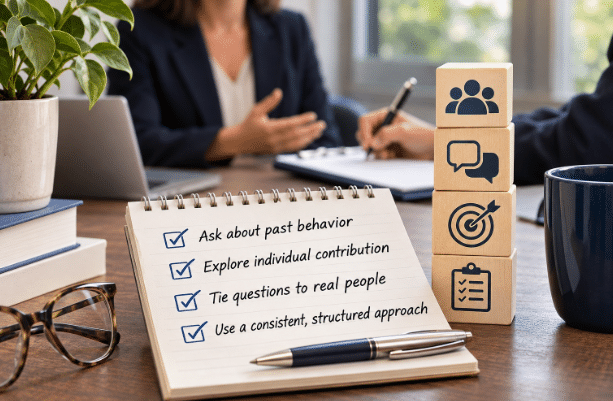
We have all hired the candidate who interviewed beautifully. The answers were polished. The panel was impressed. Someone wrote “great culture fit” on the rating sheet.
Sixty days later, the same person avoids hard conversations, will not let go of decisions, and shuts down the first time resources run short.
What happened? Odds are, nobody lied. Most interviews run like an oral exam. Forty minutes of walking through the resume, then ten minutes of “How would you resolve a conflict between two departments?” Any experienced candidate can answer that one in their sleep: clear communication, aligned priorities, everybody on the same page by Friday.
That answer tells you what the candidate knows to say. It tells you very little about what the candidate has done.
The research offers a better path. When Sackett and his colleagues reanalyzed earlier selection research, structured interviews came out on top of the procedures they studied, although results varied from one interview to the next [1]. “Structured” usually means two things: every candidate gets the same job-related questions, and the answers are rated on the same scales [2].
The four strategies below work best inside that kind of structure. None of them will eliminate rehearsed answers. Most applicants fake at least a little, and faking is very hard to detect [3].
Ask What Happened, Not What Might Happen
A hypothetical invites candidates to describe their most disciplined selves. A question about the past asks what they did during a bad week with real stakes.
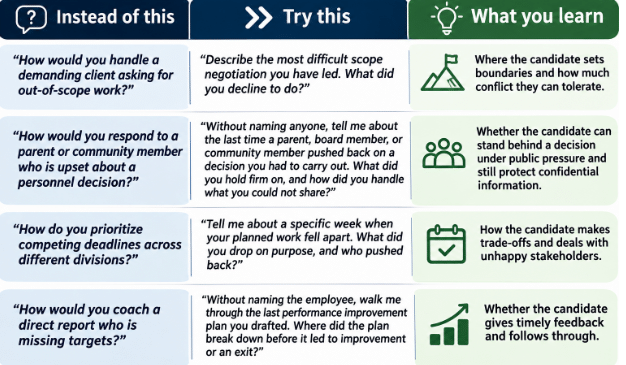
Change the verb tense. Replace “What would you do?” with “Walk me through the last time that happened.”
The numbers back this up. When researchers compared the two formats, past-behavior questions scored with descriptive rating anchors had a mean validity estimate of .63. Situational questions scored the same way came in at .47 [4]. Both did well, but the gap is real. Research on complex jobs is mixed. One analysis found that situational questions lost validity in high-complexity jobs [5], and another found no such drop [4].
Keep hypotheticals in your toolbox. A new graduate may never have faced the situation you are asking about, and the research supports using both types [2].
Listen for “We,” Then Ask About “I”
Good teams share credit. Good interview notes need more than that. “We rolled out a new system.” “We restructured the department.” “We cut turnaround time in half.” Who is “we”? And where was this candidate when it happened?
Ask:
- “You mentioned that your team redesigned onboarding. What did you personally propose, where did the team push back, and what did you give up to get it done?”
- “When the committee debated that decision, what position did you take, and why?”
Someone who did the work can usually tell you which part was theirs, where the boss stepped in, and what a coworker contributed. Someone who watched from the sidelines tends to stay with the project story.
Keep two things in mind:
- Do not penalize the pronoun. Modesty norms shape how people talk about their own accomplishments, and research ties those norms to women’s careers [6]. Plenty of candidates say “we” out of habit or courtesy, then give you a precise answer when asked. Score the answer.
- Plan your follow-ups. Research on follow-up questions is thin, and some studies link probing to more faking [2][7]. Write them in advance and use them with everyone so the comparison stays fair.
Put a Real Person in the Question
“What are your weaknesses?” should have been retired years ago. (“I care too much about the details” remains undefeated.)
Self-awareness still matters, particularly in a senior hire. You want someone who understands how their working style lands on other people. So tie the question to someone who was there:
“If I called the operations lead or HR partner who worked with you on that turnaround, what would they tell me was your most frustrating habit during high-stress weeks?”
Now the candidate is thinking about a real coworker and a real bad week. A good answer might sound like this: “They would tell you I moved too fast without documenting changes, and their team had to scramble to update the training materials.”
Then ask the question that matters: “What did you do differently after that?”
I would like to mention that a reference call keeps everyone honest. The research is less tidy. One study found that a warning about detection reduced faking [8]. A later set of studies found small effects or none when interviewees were told their answers would be verified [7]. Use this question as a good prompt, and do your reference checks anyway.
A couple of guardrails:
- Mean it. Ask this only if reference checks are really part of your process, and get the candidate’s permission before you contact a current employer.
- Stay on work habits. “High-stress weeks” can drift toward health. Before a conditional offer, employers may not ask questions likely to elicit information about a disability [9]. If the candidate goes there, do not follow up. Steer back to the work.
Pay Attention to What They Ask You
“Do you have any questions for us?” usually comes when everyone is checking the clock. It can still tell you something, especially when you are hiring a leader. Questions tend to fall into three levels. These levels describe what the candidate is focused on, and a higher level doesn’t automatically mean a better candidate.
Level 1: Logistics. “What does a typical day look like?” “What are your benefits and remote-work rules?” The candidate wants to know about the daily routine and the terms of the job.
Level 2: Operations. “What are the main goals for this role in the first 90 days?” “What systems are you moving to?” The candidate is thinking about getting started.
Level 3: The organization. “What is the biggest internal bottleneck keeping this team from reaching its goals?” “Why did the last person in this role leave?” “Where do departments most often end up at odds here?” The candidate is trying to find out how things really work and where they get stuck.
A candidate asking that third set is interviewing you, and good for them.
Now the limits. There is not much research on this. In one dissertation study, how candidates performed in the rest of the interview mattered more to ratings than the questions they asked [10]. Keep this in perspective.
And please do not mark anyone down for asking about benefits or remote work. They need that information to decide, and the question may involve caregiving, health, or accessibility. An EEOC best-practices document from 2009, now archived, advised employers to focus on qualifications and avoid caregiving questions [11].
If you plan to count candidate questions in your decision, settle ahead of time what you are measuring and make sure it fits the job. An entry-level applicant may have no reason to ask about organizational friction.
Score It the Same Way Every Time
Good questions will not save you if the panel rates candidates on rapport. Be especially careful with “culture fit.” In a study of hiring at elite professional service firms, evaluators gave real weight to shared tastes and experiences alongside skills [12]. Put plainly, people tended to favor people like themselves.
Start with the job. Decide what strong, adequate, and weak answers look like before the first interview. Structure has been linked to smaller rating differences related to race, gender, and disability [2], and clear anchors help interviewers agree [4].
These four criteria work for many professional roles. Adjust them to fit yours:
- Specifics. Did you hear real results, timelines, and trade-offs, or generalities?
- Ownership. When something went wrong, did the candidate own it, or did the market, leadership, or staff get the blame?
- Flexibility. Given a new constraint or a different view, did the candidate adapt or dig in?
- Follow-through. Can the candidate explain, step by step, how the work got done?
Interviewers are still human, and these are still judgment calls. Shared definitions make those calls more consistent and easier to defend.
Check the Rules That Apply to You
Federal law is only the starting point. States, cities, and counties often go further, and the rules change. Before you finalize your interview guide, check your state and local laws and regulations. A few examples of what you may find:
- Pay and criminal history. Some states and cities limit when you can ask about either one. Those limits can also apply to reference calls.
- Caregiving. Some states and localities directly protect parental status or family responsibilities [11].
- AI in interviews. Illinois requires notice, an explanation, and consent before using AI to analyze recorded video interviews [13].
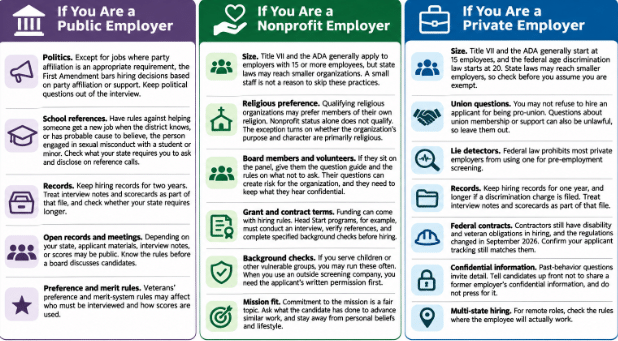
Your own rules count as well. Handbooks, hiring policies, collective bargaining agreements, board policies, and civil service rules may determine who sits on the panel, who can contact references, and how long you keep interview notes. When in doubt, call your employment counsel before the interview, not after.
The Bottom Line
Hiring mistakes are not always about skill. Sometimes the new hire can do the job but handles conflict, pressure, or decisions in ways nobody saw coming, because nobody asked.
No interview is a crystal ball. Ask what people have done. Find out which part was theirs. Listen to what they ask you. Score everyone the same way. You will still make judgment calls, but you will make them with better information.
References
- Sackett, P. R., Zhang, C., Berry, C. M., & Lievens, F. (2022). Revisiting meta-analytic estimates of validity in personnel selection: Addressing systematic overcorrection for restriction of range. Journal of Applied Psychology, 107(11), 2040–2068. https://doi.org/10.1037/apl0000994
- Levashina, J., Hartwell, C. J., Morgeson, F. P., & Campion, M. A. (2014). The structured employment interview: Narrative and quantitative review of the research literature. Personnel Psychology, 67(1), 241–293. https://doi.org/10.1111/peps.12052
- Melchers, K. G., Roulin, N., & Buehl, A.-K. (2020). A review of applicant faking in selection interviews. International Journal of Selection and Assessment, 28(2), 123–142. https://doi.org/10.1111/ijsa.12280
- Taylor, P. J., & Small, B. (2002). Asking applicants what they would do versus what they did do: A meta-analytic comparison of situational and past behavior employment interview questions. Journal of Occupational and Organizational Psychology, 75(3), 277–294. https://doi.org/10.1348/096317902320369712
- Huffcutt, A. I., Conway, J. M., Roth, P. L., & Klehe, U.-C. (2004). The impact of job complexity and study design on situational and behavioral description interview validity. International Journal of Selection and Assessment, 12(3), 262–273. https://doi.org/10.1111/j.0965-075X.2004.280_1.x
- Smith, J. L., & Huntoon, M. (2014). Women’s bragging rights: Overcoming modesty norms to facilitate women’s self-promotion. Psychology of Women Quarterly, 38(4), 447–459. https://doi.org/10.1177/0361684313515840
- Bill, B., Melchers, K. G., Buehl, A.-K., & Wank, S. (2020). An investigation of situational and dispositional antecedents of faking intentions in selection interviews. Frontiers in Psychology, 11, Article 2034. https://doi.org/10.3389/fpsyg.2020.02034
- Law, S. J., Bourdage, J., & O’Neill, T. A. (2016). To fake or not to fake: Antecedents to interview faking, warning instructions, and its impact on applicant reactions. Frontiers in Psychology, 7, Article 1771. https://doi.org/10.3389/fpsyg.2016.01771
- U.S. Equal Employment Opportunity Commission. (1995). ADA enforcement guidance: Preemployment disability-related questions and medical examinations. https://www.eeoc.gov/laws/guidance/enforcement-guidance-preemployment-disability-related-questions-and-medical
- Heimbaugh, H. G. (2016). Questioning the questioner: The effect of applicant questions on interview outcomes [Doctoral dissertation, University of Missouri-St. Louis]. https://irl.umsl.edu/dissertation/46
- U.S. Equal Employment Opportunity Commission. (2009). Employer best practices for workers with caregiving responsibilities [Archived]. https://www.eeoc.gov/laws/guidance/employer-best-practices-workers-caregiving-responsibilities
- Rivera, L. A. (2012). Hiring as cultural matching: The case of elite professional service firms. American Sociological Review, 77(6), 999–1022. https://doi.org/10.1177/0003122412463213
- Illinois Artificial Intelligence Video Interview Act, 820 ILCS 42/5. https://www.ilga.gov/Documents/legislation/ilcs/documents/082000420K5.htm
- Rutan v. Republican Party of Illinois, 497 U.S. 62 (1990). https://www.law.cornell.edu/supct/html/88-1872.ZO.html
- Prohibition on aiding and abetting sexual abuse, 20 U.S.C. § 7926. https://www.law.cornell.edu/uscode/text/20/7926
- Preservation of records made or kept, 29 C.F.R. §§ 1602.31, 1602.40. https://www.ecfr.gov/current/title-29/subtitle-B/chapter-XIV/part-1602/subpart-L/section-1602.40
- Definitions of employer, 42 U.S.C. §§ 2000e(b), 12111(5). https://www.law.cornell.edu/uscode/text/42/2000e
- U.S. Equal Employment Opportunity Commission. (2021). Section 12: Religious discrimination [Compliance manual]. https://www.eeoc.gov/laws/guidance/section-12-religious-discrimination
- Head Start Program Performance Standards, Personnel policies, 45 C.F.R. § 1302.90. https://www.headstart.gov/policy/45-cfr-chap-xiii/1302-90-personnel-policies
- U.S. Equal Employment Opportunity Commission & Federal Trade Commission. Background checks: What employers need to know. https://www.eeoc.gov/laws/guidance/background-checks-what-employers-need-know
- U.S. Equal Employment Opportunity Commission. Facts about age discrimination. https://www.eeoc.gov/sites/default/files/migrated_files/facts/age.pdf
- National Labor Relations Board. The law. https://www.nlrb.gov/about-nlrb/rights-we-protect/the-law
- U.S. Department of Labor, Wage and Hour Division. (2008). Fact sheet #36: Employee Polygraph Protection Act of 1988. https://www.dol.gov/agencies/whd/fact-sheets/36-eppa
- Preservation of records made or kept, 29 C.F.R. § 1602.14. https://www.ecfr.gov/current/title-29/subtitle-B/chapter-XIV/part-1602/subpart-C/section-1602.14
- Duane Morris LLP. (2026, August). OFCCP finalizes three rules resetting federal contractor affirmative action requirements. https://www.duanemorris.com/alerts/ofccp_finalizes_three_rules_resetting_federal_contractor_affirmative_action_requirements_0826.html