
Do You Understand Inflation?
Inflation shows up in HR work every day. It shapes salary budgets and wage scales. It drives cost-of-living clauses in collective bargaining agreements. It affects what employees pay for health coverage and how far each paycheck goes.
Employees feel rising prices long before the numbers are published, and many look to their employer for answers. HR leaders who understand inflation and the Consumer Price Index (CPI) can plan pay with confidence, bargain from solid data, and explain decisions clearly. This article covers what inflation is, how it is measured, and what it means for households and employers.
What Is Inflation?
Picture a backpack that holds everything a typical household buys in a year. Groceries. Gas. Electricity or heating oil. Rent. Doctor visits. Clothes.
Inflation is how fast the total price of that backpack goes up. When prices rise, each dollar buys a little less. This is called losing purchasing power.
What is CPI?
CPI stands for Consumer Price Index. The U.S. Bureau of Labor Statistics (BLS) publishes it every month. BLS staff collect prices in 75 urban areas, from about 6,000 housing units and about 22,000 stores, hospitals, and other businesses [1].
If the backpack cost $100 a year ago and costs $103.70 today, prices rose 3.7%. That is where things stand right now. Prices rose 3.7% over the 12 months ending in September 2026, up from 3.4% in August [1].
Two things people often get wrong about what is in the backpack:
- Housing. CPI tracks rent. For homeowners, it estimates what the home would rent for. It does not track mortgage payments [1].
- Taxes. CPI includes sales taxes and other taxes paid at the time of purchase. It does not include income tax or property tax [1].
Where Prices Stand Now
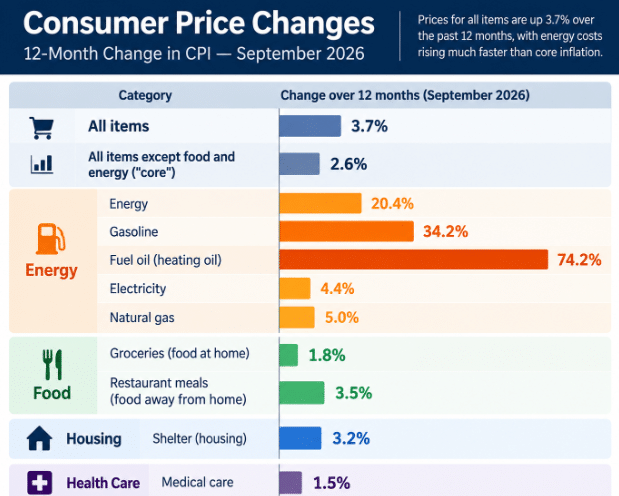
Source: BLS, Consumer Price Index, September 2026 [1][2].
The short version: 2026 inflation is mostly an energy story. Gasoline alone accounted for more than half of the September increase [1].
Why Some Prices Jump, and Others Creep
Gas and heating oil move fast. World events, supply, and weather all play a part. This year, the war involving Iran squeezed global oil and diesel supplies [6][7]. Heating oil passed $5 a gallon in March for the first time since 2022 [7]. These prices can fall fast, too. Gasoline rose 21% in March alone, dropped in June and July, then jumped 9% in September [1].
Groceries rise more steadily. Grocery prices are up 1.8% over the past year, slower than inflation overall [1]. When grocery inflation slows, prices rarely go back to where they were. They just rise more slowly.
Housing is sticky. Shelter costs are up 3.2% [1]. Once rents go up, they tend to stay up.
Healthcare is more complicated. Medical care prices in CPI rose 1.5% over the year, and prescription drug prices have been falling [1]. But CPI does not capture what workers pay toward their health insurance. Those costs are climbing much faster. According to KFF, the average family premium for employer coverage reached $28,303 in 2026, up 5%. The worker share rose 9% to $7,471 [8].
Inflation Is Not the Same Everywhere
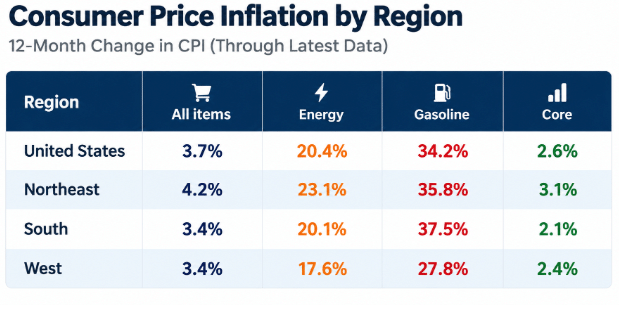
Source: BLS regional CPI reports, 12 months ending September 2026 [1][3][4][5].
United States. Prices rose 3.7% nationally, with energy doing most of the lifting. Energy costs rose 20.4%, led by a 34.2% jump in gasoline. Without food and energy, prices rose a more modest 2.6% [1]. This is the benchmark each region is measured against.
Northeast. Prices are rising faster here than the national average. Heating oil is a big reason. About 3% of U.S. homes heat with oil, mostly in the Northeast [11]. The U.S. Energy Information Administration (EIA) expects those households to spend about 21% more this winter, averaging $2,115 from November through March [6][10]. About half of all households heat with natural gas or propane and are expected to spend less [11].
South. Overall inflation is lower, and core prices are rising more slowly than in the Northeast or West [3][4][5]. Summer air conditioning drives electric bills. Several Southern states, including Florida and Texas, have no state income tax, but other housing costs can eat into those savings.
West. Overall inflation matches the South at 3.4%. Energy rose less here than in other regions, up 17.6%, while gasoline rose 27.8%. Food is the exception: it rose 2.8%, a bit faster than the 2.5% national rate. Shelter costs rose 3.0% [1][5].
Five years later: what this looks like for real households
Since September 2021, prices are up about 23% [1][12]. Something that cost $100 then costs about $123 now.
Here is how that plays out for three households. Take-home pay figures are rough estimates after federal, state, and payroll taxes, which vary by state.
Single person, $45,000 income (about $3,000 a month take-home)
- Renter: A $1,300 rent takes more than 40% of take-home pay. If that rent rose with overall inflation, it is now about $1,600. Something has to give, whether that means cutting savings, cutting extras, or moving to a smaller apartment.
- Homeowner: A fixed-rate mortgage locks in the principal and interest. Property taxes, insurance, repairs, and heating still go up, and they take a bigger share of a tight budget.
Married couple, $80,000 income (about $5,300 a month take-home)
- Renter: More room to breathe than a single earner. But each rent increase cuts into down payment savings.
- Homeowner: A fixed mortgage payment works as a shield. Groceries and energy go up, but the largest monthly bill stays the same.
Family of four, $100,000 income (about $6,400 a month take-home)
- Renter: Pressure from several directions at once: groceries for four, a larger rental, and health coverage. The average worker share of a family premium is now about $620 a month [8].
- Homeowner: The most protected of the three. Still, healthcare, groceries, and property taxes require careful year-to-year planning.
What this means for employers
Pay planning. Employees feel the prices they pay, not the national headline. A worker heating with oil in Vermont is facing a very different winter than a worker heating with natural gas.
Contracts tied to CPI. Many collective bargaining agreements and pension plans tie increases to CPI [1]. The BLS recommends using the unadjusted index, not the seasonally adjusted one [1]. Check which index your contract names. CPI-W, the index for wage earners, rose 3.9%, higher than the 3.7% headline [1].
Social Security and payroll. Social Security benefits will rise 3.6% in 2027, the largest increase in five years [9]. The wage base subject to Social Security tax rises to $192,300 from $184,500 [9]. Update payroll systems before January.
Benefits. Health premiums are rising faster than both prices and wages [8]. Clear communication during open enrollment matters more than ever.
Key takeaways
- CPI measures how the prices of everyday goods and services change over time.
- Right now, energy is driving inflation. Gas and heating oil swing up and down quickly.
- Housing, groceries, and healthcare costs rise more slowly and tend to stay up.
- Where you live and how you heat your home make a real difference.
- A fixed-rate mortgage protects against rising housing costs. Renters feel increases each time a lease renews.
References
Figures are from the September 2026 Consumer Price Index report, released October 14, 2026. The October report comes out November 10, 2026.
- U.S. Bureau of Labor Statistics. Consumer Price Index – September 2026 (October 14, 2026). https://www.bls.gov/news.release/cpi.nr0.htm
- U.S. Bureau of Labor Statistics. Gasoline prices increased 34.2 percent over the year ended September 2026. The Economics Daily. https://www.bls.gov/opub/ted/2026/prices-for-gasoline-increased-34-2-percent-over-the-year-ended-september-2026.htm
- U.S. Bureau of Labor Statistics. Consumer Price Index, Northeast Region – September 2026. https://www.bls.gov/regions/mid-atlantic/news-release/consumerpriceindex_northeast.htm
- U.S. Bureau of Labor Statistics. Consumer Price Index, South Region – September 2026. https://www.bls.gov/regions/southeast/news-release/consumerpriceindex_south.htm
- U.S. Bureau of Labor Statistics. Consumer Price Index, West Region – September 2026. https://www.bls.gov/regions/west/news-release/consumerpriceindex_west.htm
- U.S. Energy Information Administration. EIA expects a mixed picture for winter fuel costs this year (October 6, 2026). https://www.eia.gov/pressroom/releases/press593.php
- Bloomberg Government. $5 Heating Oil Arrives in US in Latest Iran War Fuel Pain Point (March 12, 2026). https://news.bgov.com/bloomberg-government-news/5-heating-oil-arrives-in-us-in-latest-iran-war-fuel-pain-point
- KFF. 2026 Employer Health Benefits Survey (October 22, 2026). https://www.kff.org/health-costs/2026-employer-health-benefits-survey/
- Social Security Administration. Social Security Announces 3.6 Percent Benefit Increase for 2027 (October 14, 2026). https://www.ssa.gov/news/en/mip/2026-10-01-f.html
- The FINANCIAL. Winter Heating Costs Split as EIA Forecasts a 21% Rise for Oil Users (October 7, 2026). https://finchannel.com/winter-heating-costs-split-as-eia-forecasts-a-21-rise-for-oil-users/137288/energy/2026/10/
- Reuters, via American Journal of Transportation. EIA expects a mixed picture for US households’ winter fuel costs this year (October 6, 2026). https://www.ajot.com/news/eia-expects-a-mixed-picture-for-us-households-winter-fuel-costs-this-year
- U.S. Bureau of Labor Statistics. CPI Inflation Calculator. https://www.bls.gov/data/inflation_calculator.htm